Labels and certifications have become essential benchmarks in the cosmetics industry. Beyond marketing, they define a precise technical framework that directly influences how formulas are designed. Surfactants, essential components of cleansing, conditioning, and emulsifying products, are among the ingredients most strictly regulated by these standards.
Understanding What These Certifications Cover
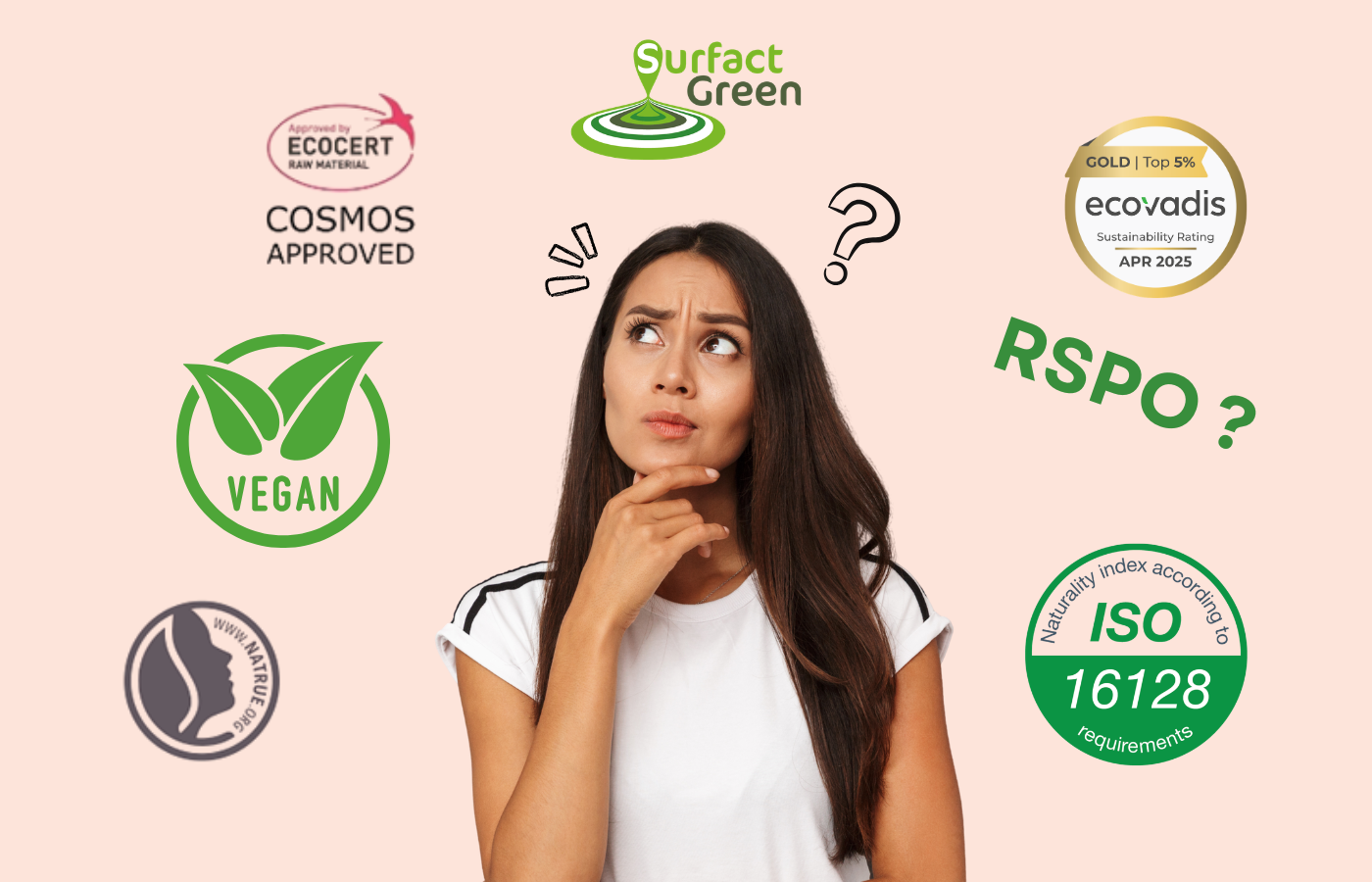
Certifications such as COSMOS and ECOCERT have established a clear distinction between “natural” ingredients and those “of natural origin.” An ingredient is considered natural when it comes directly from nature without chemical processing: vegetable oils, butters, clays, floral waters, etc.
In contrast, an ingredient of natural origin may be obtained through chemical processing, provided that the raw material is renewable and the process used is among those authorized. These processes, like esterification, fermentation, hydrolysis, and mild hydrogenation, must comply with the principles of sustainable chemistry : high efficiency, limited use of solvents, absence of toxic residues, and biodegradability of the final product.
Therefore, it is not “green chemistry” that defines an ingredient’s natural properties, but it is an essential prerequisite for a surfactant to comply with COSMOS or ECOCERT standards.
NATRUE: A More Complete Approach
The NATRUE label stands out for its more holistic view of naturalness. While COSMOS and ECOCERT review each ingredient individually for compliance, NATRUE evaluates the overall consistency of the formula.
It distinguishes between three levels: natural products, products of natural origin, and near-natural products. This gradation allows for the integration of innovations while preserving the original philosophy: authentic cosmetics that respect the environment and human health.
For surfactants, this means that their selection depends not only on their chemical origin but also on their compatibility with the formula as a whole and their overall impact on the product’s life cycle.
Ethics as a plus : the “Vegan” label
The “Vegan” label is not based on chemical standards but on an ethical commitment. It guarantees the complete absence of ingredients derived from animals or tested on them.
In the case of surfactants, this requirement excludes certain raw materials such as animal fats or lanolin derivatives, which are sometimes used in traditional conditioning agents. Combined with eco-certifications, the “Vegan” approach drives formulation efforts toward finding 100% plant-based alternatives while maintaining an equivalent level of effectiveness.
Beyond Organic : Traceability and Aquatic Impact
Alongside COSMOS and NATRUE, other technical standards guide the choices of raw material buyers. The ISO 16128 standard allows for the precise measurement of the natural content of molecules, while RSPO certification guarantees sustainable and ethical sourcing of the palm oil used in the synthesis of surfactants.
CosmeGreen: A technical solution to regulatory challenges
From an industrial and formulation perspective, the conditioning and detangling agents in the CosmeGreen line overcome the historical technical limitations of bio-based cationic surfactants.
Where conventional green alternatives impose strict formulation requirements and limit the choice of other ingredients, CosmeGreen™ EASY HC integrates very easily. It will significantly enhance the naturalness of your formulations with performance comparable to BTAC, without requiring a complex step to adjust the formulation’s pH. At the same time, CosmeGreen™ HF30 offers an effective and natural alternative to SLES, producing a rich, dense, white foam while exhibiting extremely low irritation potential.
A new standard for responsible formulation.
Certifications are no longer just indicators of naturalness: they are redefining the way products are designed. Their influence is felt at every stage of the supply chain: from the selection of raw materials to consumer communication. For formulators, these standards represent an opportunity. They promote the development of safer ingredients and more consistent cosmetics.
This is the vision that SurfactGreen stands for through its innovations: reconciling scientific performance and environmental responsibility, without compromise.