The clean beauty revolution has fundamentally transformed the cosmetics industry but formulating a truly natural and sustainable conditioner remains one of the greatest challenges for cosmetic chemists. While skin care formulations have easily transitioned to green chemistry, hair care requires highly specific mechanisms, namely, cationicity, to neutralize the negative charge of damaged hair fibers, reduce friction, and provide detangling properties.
Historically, the industry has relied on petrochemical-derived molecules to achieve these results. Today, modern formulation must balance exceptional sensory performance with uncompromising environmental responsibility. This guide breaks down the evolution of conditioning agents, the limitations of current market alternatives, and how to formulate high-performance, eco-friendly hair care using next-generation green chemistry.
The Environmental Cost of Conventional Conditioning Agents
For decades, the golden standard for hair conditioning has been traditional quaternary ammonium compounds (QACs), particularly Behentrimonium Chloride (BTAC) and Cetrimonium Chloride (CTAC). These alkyl quats provide excellent substantivity, wet combing, and static reduction. However, their environmental profile is deeply problematic.
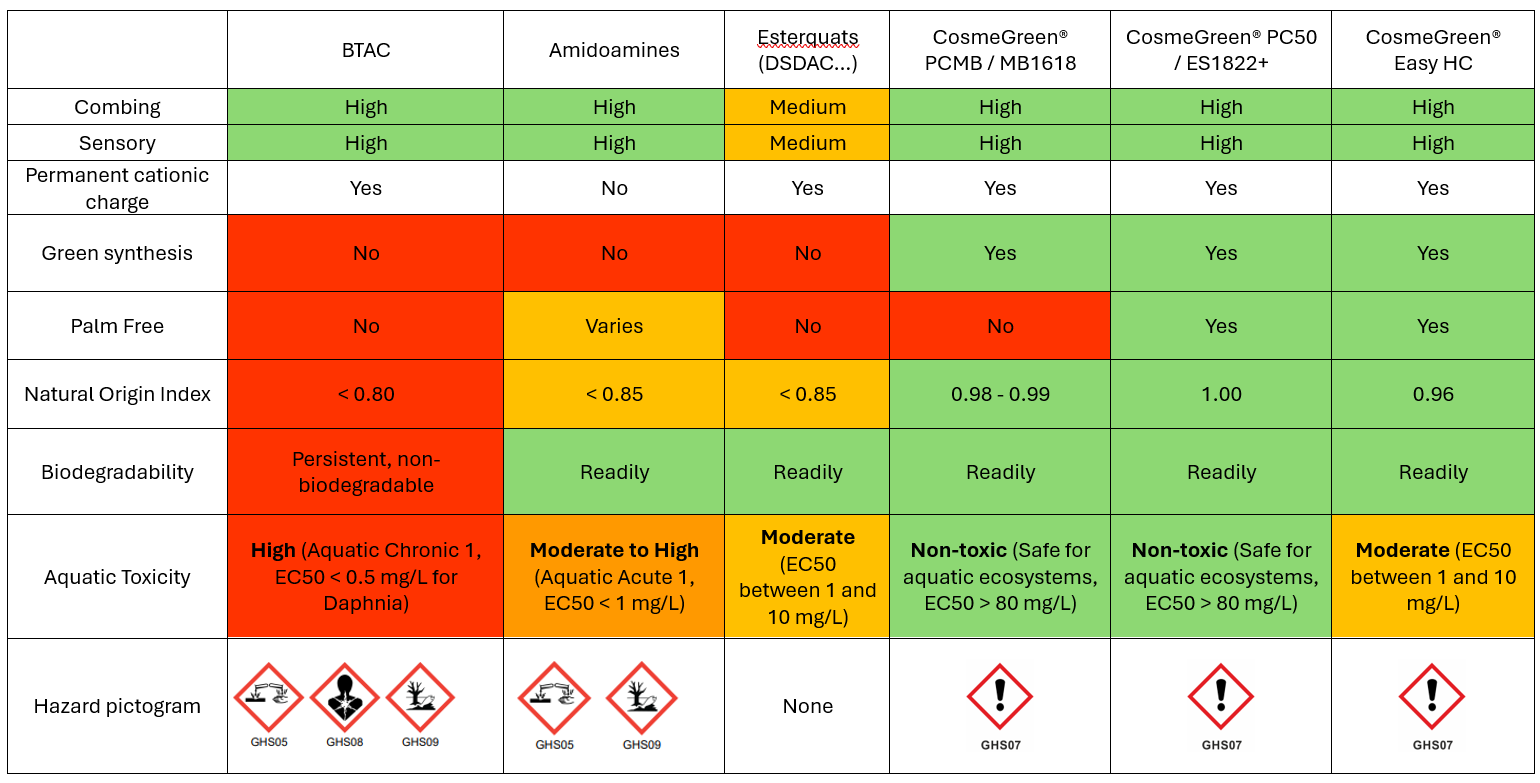
- Aquatic Toxicity: According to data from the European Chemicals Agency (ECHA), many traditional QACs are classified as highly toxic to aquatic life with long-lasting effects (Aquatic Chronic 1). Their EC50 values (the concentration that affects 50% of the test population, such as Daphnia magna) frequently fall below 0.5-1 mg/L.
- Poor Biodegradability: Traditional alkyl quats strongly adsorb organic matter and resist microbial breakdowns, failing rapid degradation tests (such as OECD 301) and leading to accumulation in waterways and marine ecosystems.
- Petrochemical Origins: The carbon chains and synthesis pathways for these conventional ingredients are heavily reliant on fossil fuels, contributing significantly to a brand’s Scope 3 carbon emissions. The synthesis of alkyl quats like BTAC relies on energy-intensive quaternization steps requiring petrochemical intermediates and hazardous reagents such as methyl chloride or dimethyl sulfate—toxic alkylating agents posing severe occupational handling risks.
For the modern consumer, these technical limitations translate into a growing ethical dilemma. Every rinse of a traditional BTAC-based conditioner washes non-biodegradable, ecotoxic molecules directly into domestic wastewater and local aquatic ecosystems—a process completely at odds with the expectations of “Clean Beauty.” Furthermore, persistent quats can build up on hair over time, leaving a heavy residue that requires aggressive clarifying shampoos to remove. Formulating without conventional QACs allows brands to offer transparent, rinse-off formulas that combine effortless detangling with a clean environmental conscience.
In an attempt to solve the biodegradability issue, the industry developed Esterquats. By introducing an ester bond into the molecule, these agents become susceptible to hydrolysis and microbial degradation. However, petrochemical quaternization steps are still needed to obtain the permanent cationic charge like BTAC. Esterquats often suffer from hydrolytic instability at varying pH levels and typically deliver inferior conditioning performance compared to their BTAC counterparts, leaving formulators to compromise on efficacy.
The Limitations of Current “Green” Alternatives
As consumer demand for sustainable hair care surged, ingredient suppliers introduced several alternatives. While these offer marginal environmental improvements, they often fall short on the pillars of green chemistry and sensory performance.
- Amidoamines (e.g., Stearamidopropyl Dimethylamine): These require in-situ neutralization with an acid to become cationic. While they perform adequately, their synthesis still heavily relies on the petrochemical precursor dimethylaminopropylamine (DMAPA), produced via multi-step synthesis involving acrylonitrile and dimethylamine, associated with volatile organic compound (VOC) emissions and high energy consumption.
- Polyquaterniums and Silicones: Often used to mask the performance gaps of weak natural conditioning agents, these synthetic polymers act as liquid microplastics. They are highly persistent in the environment and are increasingly restricted by global cosmetic regulations and eco-labels (such as COSMOS and Ecolabel).
- Non-Ionic Natural Alternatives: Using excessive amounts of plant oils, butters, or brassica-derived alcohols can mimic a conditioning feel but fail to bind to the hair fiber (lack of substantivity). This results in a heavy, greasy feel rather than true detangling and repair.
The Breakthrough: Formulating with CosmeGreen® by SurfactGreen
To bridge the gap between uncompromising performance and radical sustainability, SurfactGreen developed the CosmeGreen® range. Engineered through the strict principles of green chemistry, CosmeGreen® offers a true, high-performance alternative to BTAC and conventional cationics.
Key advantages for modern sustainable formulations:
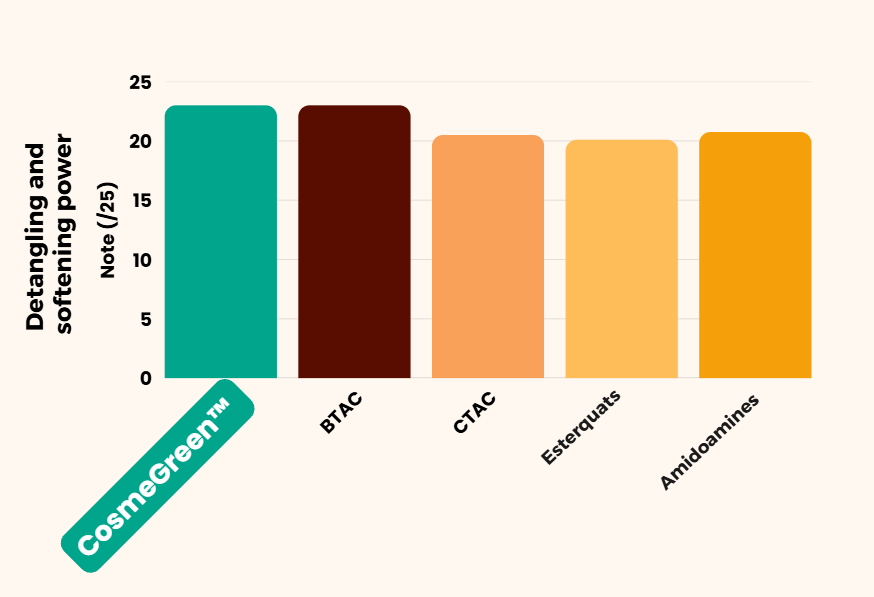
- Uncompromised Performance: Instrumental combing tests demonstrate that CosmeGreen® provides wet and dry detangling, smoothing, and anti-frizz properties that match BTAC at equivalent active levels.
- Up to 100% Natural Origin Index: Fully compliant with ISO 16128, the range is derived from upcycled local biomass, specifically sugar beet.
- Readily Biodegradable: Unlike traditional quats, CosmeGreen® ingredients are engineered for rapid and complete breakdown in aquatic environments, ensuring no bioaccumulation or long-term aquatic toxicity.
- Frictionless Formulation: It is supplied in easy-to-handle formats, compatible with a wide range of natural oils, biopolymers, and active ingredients.
- Guided by green chemistry principles: In stark contrast with the conditioning agent mentioned earlier, the synthesis of the CosmeGreen range follows a streamlined “one-pot” bio-based reaction. By reacting upcycled plant lipids with natural bio-sourced amines without organic solvents, toxic alkylating agents, or hazardous heavy metal catalysts, the manufacturing process yields only water and ethanol as byproducts. No quaternization step is needed as the upcycled biomass from sugar beet already has a permanent cationic charge. This drastic reduction in reaction steps, toxic reagents, and process waste aligns directly with Principles 2 (Atom Economy), 3 (Less Hazardous Syntheses), and 5 (Safer Solvents) of Green Chemistry.
Embracing Upcycled Beauty and Zero Waste
Beyond simple biodegradability, the CosmeGreen® range taps into the highly sought-after “Upcycled Beauty” trend. Instead of growing crops specifically for cosmetic ingredients, which competes with food production, SurfactGreen utilizes agricultural byproducts. The core raw material for CosmeGreen® is derived from the upcycled remnants of European sugar beets. This circular economy approach drastically reduces the carbon footprint and water usage associated with ingredient sourcing, providing a compelling sustainability story for eco-conscious consumers.
Transitioning to sustainable hair care no longer requires a choice between environmental ethics and consumer satisfaction. By leveraging advanced bio-based chemistry and moving away from persistent, toxic legacy ingredients, cosmetic brands can formulate clean, high-performance hair care that respects both the consumer and the planet.
Frequently Asked Questions (FAQ)
What is the best natural alternative to BTAC in cosmetics?
The best natural alternative to Behentrimonium Chloride (BTAC) is an upcycled, plant-based cationic agent like those found in the CosmeGreen® range by SurfactGreen. They offer the same detangling and smoothing performance as BTAC but are up to 100% natural-origin (ISO 16128) and readily biodegradable without aquatic toxicity.
Why are conventional quats like BTAC bad for the environment?
Conventional quats are highly toxic to aquatic life (Aquatic Chronic 1) with EC50 values often below 0.5 mg/L. Because they resist microbial breakdowns and fail standard OECD 301 tests, they persist in waterways and marine ecosystems, causing long-term environmental damage.
Are the CosmeGreen ingredients self-emulsifiers like conventional conditioning agents?
Yes, the CosmeGreen ES1822+, MB1618, PC50, PCMB and Easy HC are self-emulsifiers. No co-emulsifier is required to emulsify your formulas.